

A new era of national awakening is beginning in Europe, which for decades remained trapped in the ideologies of Brussels. The war in the Middle East and the failure of the globalized economy to protect citizens from high prices are now acting as the catalyst that is bringing down the edifice of the "liberal center." While technocrats speak of a "slow death" for the economy, the European people are making their choice. From the France of Emmanuel Macron, who sees his dominance collapsing under the weight of national forces, to the heart of Germany and the Balkans, patriotic movements are galloping toward power.
The Brussels establishment watches in terror as the masses reject the failed experiments of the past, seeking security, borders, and national dignity.
From economic shock to… political crisis
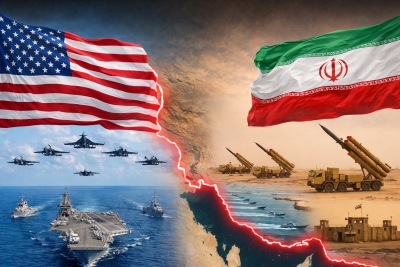
European leaders have a new fear: Donald Trump’s confrontation with Iran is about to turn from an economic shock into a political crisis for the Union's fragile center.
With energy prices rising and growth slowing down, pro-European governments are bracing for a crisis they have little power to stop, and which could dismantle the bloc’s already weakened political establishment. Across Europe, unpopular governments face a populist backlash that could strike hard enough next year in France to propel "National Rally" to victory, placing the far-right in the Elysee Palace and sending shockwaves around the world.
"The cost of energy is being passed on to food, transport, and housing, hitting low- and middle-income households the hardest," Seamus Boland, president of the European Economic and Social Committee, told Politico. The committee brings together trade unions from across Europe and advises the European Commission on economic and labor policy. "Politically, this creates space for distrust, not only toward national governments but also in the ability of European institutions to protect citizens from external shocks. It risks accelerating support for more protective or inward-looking approaches."
France is the biggest prize. But it is not the only sign in Europe that the center is collapsing.
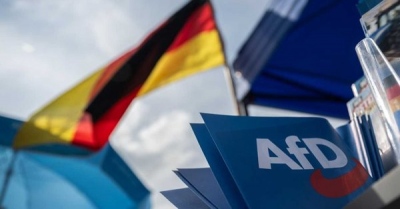
In Bulgaria, the victory of Kremlin-friendly former president Rumen Radev on April 20 has put governments across Europe on alert. In Romania, a government crisis could soon remove pro-European Prime Minister Ilie Bolojan from power. In Germany, the far-right "Alternative for Germany" (AfD) is eyeing gains in the Saxony-Anhalt state elections in September, having already made inroads into parts of western Germany, far from its traditional base in the east.
Alarm bells
When European leaders held a two-day Summit in Cyprus last week, while economic officials and experts were meeting in Greece, one common element was evident in private meetings, informal discussions, and public statements: Europe's economy is already weak, and the Iran shock threatens to make it politically explosive.
"As the blockade of the Strait of Hormuz persists, it is clear that its effects are becoming more pronounced and, some say, spreading to the wider economy," European Commissioner for the Economy Valdis Dombrovskis told Politico on the sidelines of the Delphi Economic Forum in Greece. "Our advice is to stick to temporary and targeted measures to limit their fiscal impact, because fiscal space is now more limited than it was during the Covid-19 era and the first energy crisis [triggered by Russia's full-scale invasion of Ukraine] in 2022."
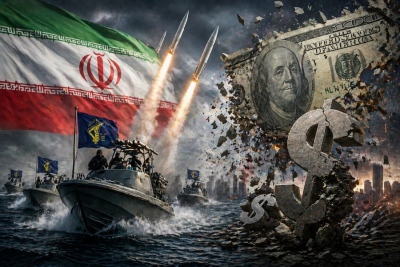
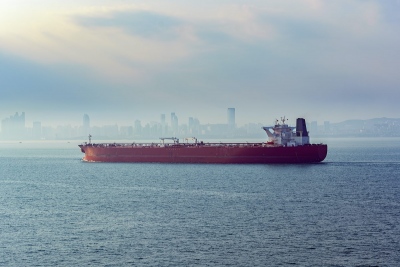
The standoff between the US and Iran is being prolonged after the last-minute cancellation of recent talks. The Strait of Hormuz remains closed to most commercial shipping, keeping the price of oil above $100 a barrel.
The attacks led by the US and Israel are the latest — and most acute — cause for Europe's economic alarm. But the bells have been ringing for years. Europe was at risk of a "slow death" unless leaders moved forward with extensive reforms to catch up with faster-growing China and the US, former European Central Bank head Mario Draghi warned in 2024.
"We must not underestimate that this is a unique moment where an American president, a Russian president, and a Chinese president are diametrically opposed to the Europeans," French President Emmanuel Macron said from Athens, where he held talks with Greek Prime Minister Kyriakos Mitsotakis after the EU Summit. "Therefore, this is the right time to wake up."
In a sign of growing economic pressures, the two leaders used their meeting to call for an extension of the repayment of the EU post-pandemic recovery plan and the creation of more European debt to fund the bloc's investment priorities.
Downgrade of economic forecasts
The economic sluggishness that has haunted Europe for years is turning into something more urgent: stagflation. Rising prices caused by war and the blockade are colliding with weak growth across the Union.
While once considered temporary, the crisis is now expected to have long-lasting effects and is spreading to the broader economy, Dombrovskis said. "We are facing stagflation — an economic slowdown and increased inflation simultaneously," he told Politico. "It is almost certain that we will have to revise downward our economic forecast [for the full year] in our spring forecasts in the second half of May."
Germany and Italy — which together represent more than a third of the EU's total GDP — have both downgraded their economic forecasts for the full year in recent days. At last week's Summit, EU leaders examined Commission proposals to cushion the impact of the energy crisis, including cuts to electricity taxes, social programs for vulnerable households, VAT reductions, targeted subsidies for clean technologies, investments in energy grids, and coordinated replenishment of gas stocks.
But there are limits to what Brussels — or cash-strapped national governments — can do.
Many EU countries are still laboring under the weight of high debts and deficits inherited from pandemic-era financial support programs. This leaves little room for the kind of sweeping intervention Europe implemented at the onset of Covid or after Russia's full-scale invasion of Ukraine. Dombrovskis said the Commission avoided "bazooka-type" measures and called on governments to stick to "targeted, temporary" support — in other words, to intervene only where the pain is most acute.
www.bankingnews.gr


Σχόλια αναγνωστών